Balancing a full time job with being a dual-code international – Ffion Lewis interview.

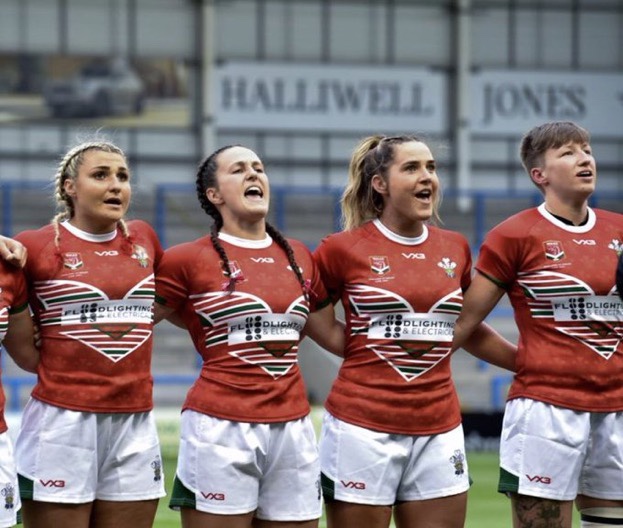
Ffion Lewis and her Wales teammates singing the anthem

Balancing a full time job with playing international rugby is tough at the best of times but when you’re a dual-code international whilst holding down a full time teacher’s job the workload must be tiring, both physically and mentally.

However, that’s the reality for Wales captain Ffion Lewis who will lead her country out at Parc Eirias on Sunday when Wales take on Ireland, 2.30pm kick off.

“I’m not going to sugar-coat it, it is really hard. They are really long days, I leave for work at 7 every morning, I’m teaching by 9 and most days I don’t get home until 10/11 in the night.

At the end of the day though opportunities like Sunday when I’m captaining my country and when I’m standing there signing the anthem makes what I do worth it. It’s a situation where we haven’t really known any different. We’ve got to make these sacrifices in women’s sport to achieve things like we are.”

Lewis, who currently plays union for Worcester Warriors in the Allianz Premier 15’s, has been called up to the Wales union squad for their three match autumn series where they’ll take on Japan, South Africa and Canada. However it’s her form playing league in the Betfred Super League for the Cardiff Demons which has seen her called into the Wales set-up and subsequently given the captaincy.
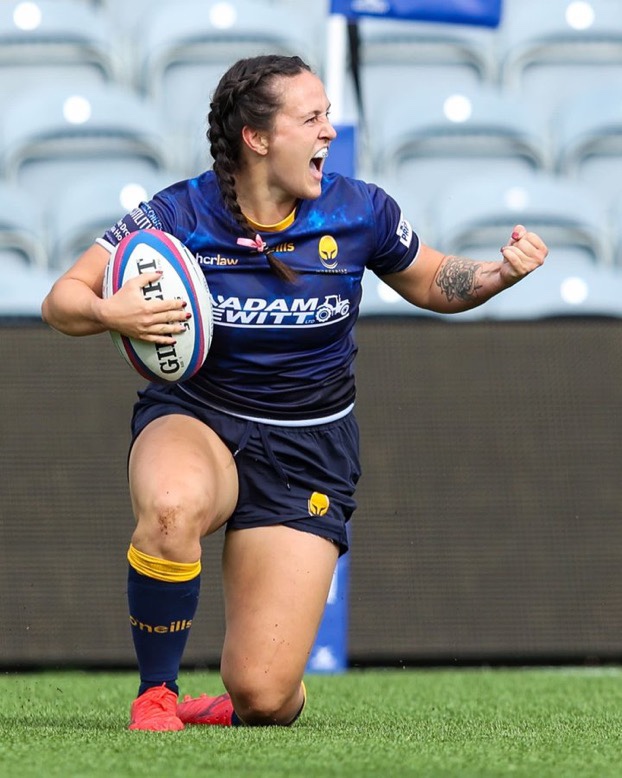
Lewis in action for her rugby union team, Worcester Warriors.

“Being honest I’ve had a tough rollercoaster with union in regards to selection. I had a shoulder injury in January and selection didn’t go my way.
An opportunity came up with rugby league in my position, and I was struggling in regards to how much I was enjoying my rugby at that moment in time. I was at a time where I either concentrated a little bit more on my work career or I took the opportunity with league. I put my hand up for it and I haven’t looked back.

It’s something I’m so glad I’ve done. It’s changed my game so much in a positive way and I’ve met so many great people along the way. Our coach Tom Brindle is the greatest coach I’ve ever had and the experiences I’ve had in league have been great for me as a player and as a person.”

Lewis became Wales’ 100th dual-code international when she took to the field in June for Wales’ game against England in Warrington, a prestigious list that has seen the likes of Jonathan Davies, Scott Gibbs and Scott Quinnell all go before her. However, Lewis is a trailblazer in the sense she’s playing league and union at the same time.

“At the beginning it was really difficult switching between league and union. I’ve played union since I was six years old, but league is so tactical.

At the start I just didn’t get league! But as soon as I started learning all of the nitty gritty parts of the game it became okay. In the beginning it was hard but now I’m playing them both at the same time I don’t find the transition hard.”

With Wales being a relatively new team in the women’s rugby league world, having only been formed in 2019, have missed out on the world cup originally scheduled for this autumn but will be looking to make the showpiece event when it rolls around in 2025.

“We just missed out this year which is a massive shame but qualifying for 2025 will now be the goal. The union world cup is next year and I’m hoping I can make that and tick that box before focussing on 2025 with the league team.

I would be speechless if I had the opportunity to captain my team at the world cup, it would be a huge honour. We’ve got to get there first though so fingers crossed we make it and get ourselves a spot”

Music In Sport


Music plays a massive role in sport, particularly in Welsh Rugby. There has always been a big emphasis on singing the anthem and songs like Bread of Heaven, Hymns and Arias and Sosban Fach are all known as Welsh Rugby songs and can be heard from the terraces of the Principality Stadium on a match day.


Football clubs and music also go hand in hand, too. The vast majority of clubs around the world have a song or chant that is seen as their own and can instantly make supporters feel a connection to the club when that music plays. Liverpool have ‘You’ll Never Walk Alone”, Manchester City have “Blue Moon” and even closer to home, Swansea City have “Take Me To The Vetch Field”. Music plays a huge role in the identity of these clubs and their supporters.


Music has a big role to play in sports like Darts and Boxing, as each athlete has their own walk out music, which again becomes part of them and when the song is heard it’s recognisable with the athlete that it’s used by.


Music and popular songs are also used in football chants sung in the terraces and songs like “Sweet Caroline” are often sung by fans at boxing fights and darts events. Music plays a huge role in sport however it’s not without its controversies.


England Rugby supporters chant of ‘Swing low, sweet chariot’ has been deemed controversial due to the links to slavery, and there have been people who have come out against the RFU and requested that the song should not be sung anymore at Twickenham.


The RFU has said that the singing of the song will not be banned at Twickenham, but they will stop putting the lyrics to the song up on the big screen, and hoardings around the stadium.


In June 2020, due to the emergence of the BLM movement, RFU bosses conducted a review into whether the song should be sung, and England player Maro Itoje admitted that it made him feel ‘uncomfortable’. However, it has not be banned.

This just goes to show how music in sport has become so embedded into the traditions of some teams and the huge role music actually has in the sporting world.

International Women’s Day 2021

International Women’s Day is a day that celebrates ‘the social, economic, cultural and political achievements of women’ whilst also trying to call for equality in society where men and women are treated equally and fairly.


It’s a day where women celebrate achievements and more importantly try and raise awareness of equality – https://www.internationalwomensday.com/Activity/15586/The-history-of-IWD


The first IWD came in 1909, and it has grown each year to the massive event we know it as now. In 2001 the internationalwomensday.complatform was launched to try and reenergise the day while continuing the call for accelerating gender parity.


Speaking about international mens day (which takes place on the 19th November) on IWD isn’t in the spirit of the occasion because one of the purposes of IWD is to try and campaign for equality in a number of aspects of every day life with men so mentioning IMD is rather insensitive as it contradicts the purpose of IWD.


Listening to Sarra Elgan of BT Sport and S4c she spoke about times where she’s had criticism online purely because of her gender and spoke about Sonja McLaughlan and the sheer levels of abuse she received after the Wales vs England post match press conference just last week.


This tells me that women working in the media are more susceptible to receiving online abuse from trolls on social media as some people wrongly think that they’re not worthy of doing the job they are doing and so people are quick to pounce and dish out abuse if they’re not happy with what they’ve done, compared to men who often don’t receive the same levels of abuse on social media.

This goes to show that days like International Women’s Day continue to be as important as ever in the battle for equality and in the battle for all women to have their voice heard.

‘Time to Talk’ day review

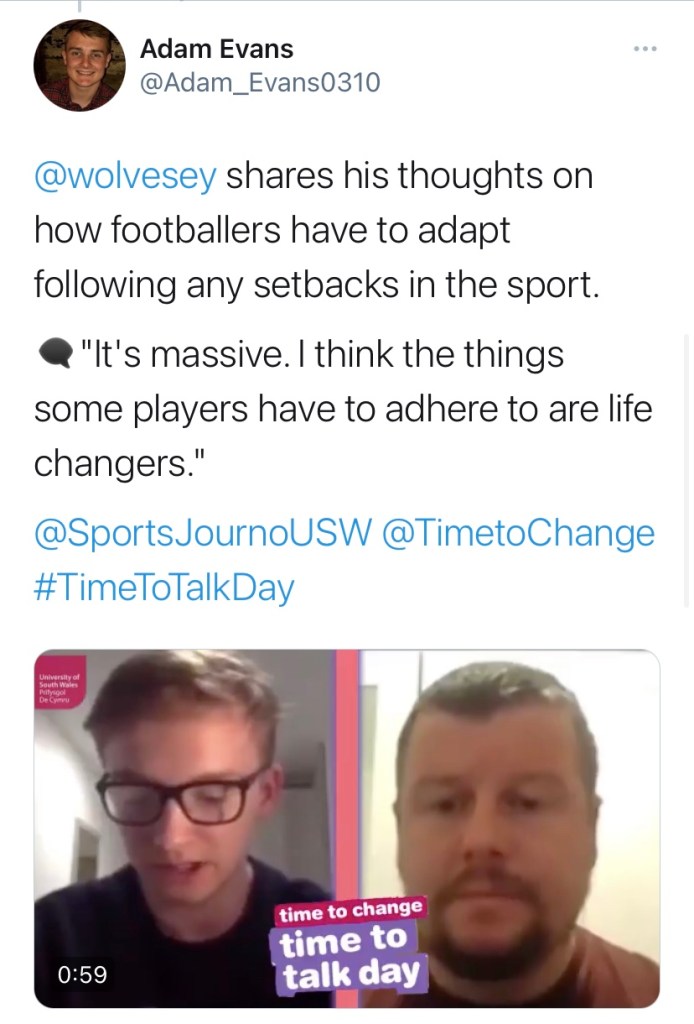
The Time to Talk day last Thursday (04/02/21) was a successful day with all four groups producing a high standard of work, with all four groups coming up with unique ideas to mark the day.

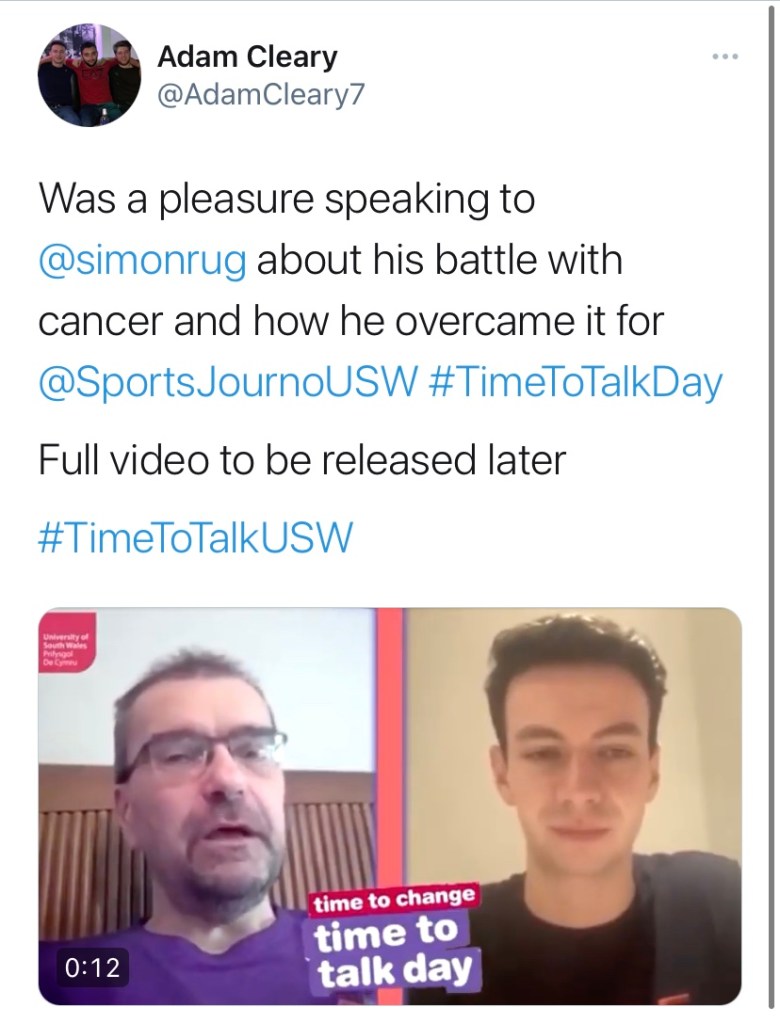
My group went for the approach of interviewing relevant people and getting their story on the theme of ‘bouncebacks’. Dafydd Jones spoke to Haverfordwest County manager Wayne Jones, this was appropriate as Wayne Jones works for the NHS as a mental health worker which meant he was in a great position to speak about an event like ‘time to talk.’

I was fortunate enough to conduct the second interview, interviewing Welsh Rugby journalist Simon Thomas. In 2018 Simon had a battle with cancer and he really opened up on his battle with cancer and about how his sense of humour helped him pull through the toughest of times. It was quite an emotional interview and I felt as if the questions were good as they allowed him to go in to detail and really open up.

I think I worked well in a team and did my assigned role to the best of my ability. We all pulled together as a group to try and find appropriate guests and think the guests we managed to find were perfect for Thursday’s event.

Link – https://youtu.be/8PSJvS7mUpE

In terms of improvements, I think it would have been good to have had more views on the YouTube video as it currently only has 158 views which is a tad disappointing especially as the clips myself and Dafydd have posted on twitter have gained more views than that.

We’ve all done our best to spread the word and we’ve all shared clips on our social media pages to try and get more views on the video which we all worked hard and took part in to produce. There was a good reaction to the video however with people praising Wayne Jones and Simon Thomas for coming out and speaking to us about such a crucial topic.

Time To Talk Day

‘Time To Talk Day’ is a very important day every year but this year it’s of increased importance with lockdown and coronavirus restrictions impacting every single person one way or another. It’s been a tough year since the initial lockdown was put into place in March last year so it’s important this year that there’s increased attention on the time to talk day. As a course it’s been great speaking to people like Simon Thomas and his battle with cancer and subsequent recovery, and it’s great that as a course we can try and raise awareness of mental health and of time to talk day.”

Inside the Cage Documentary

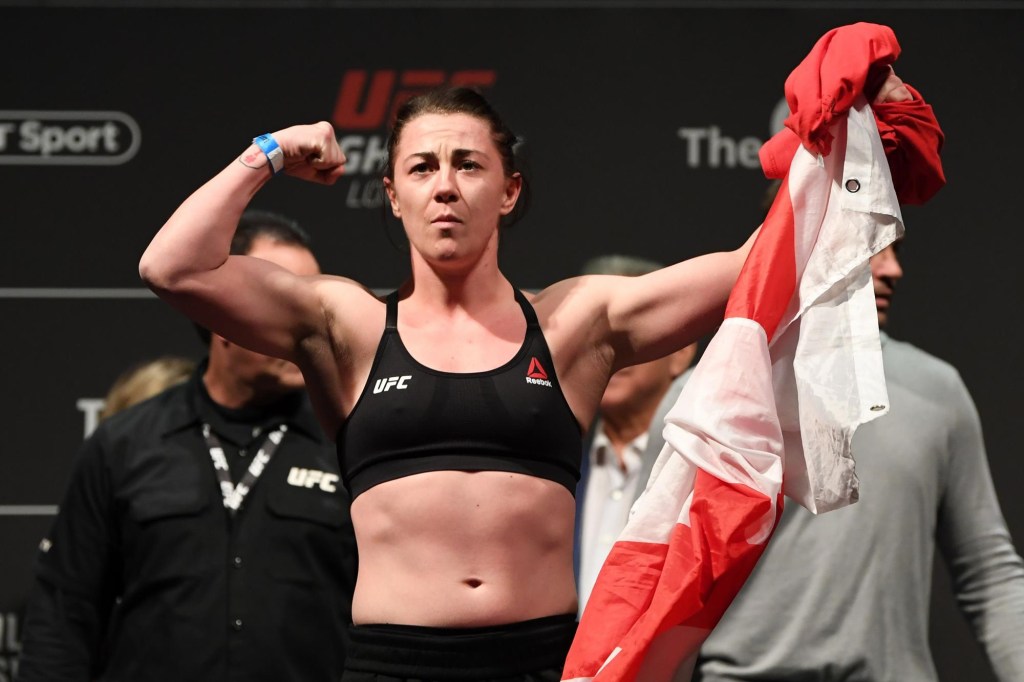
The ‘Inside the Cage’ documentary follows the story of three British female MMA fighters, Molly McCann, Shanelle Dyer and Cory McKenna. Annie Price follows these fighters and documents their career paths over a number of fights.

The way it’s presented and scripted is interesting due to the way it switches between the three women involved throughout, showing their build up from their training camps to the fight which could potentially change their life and help them progress further to make more money from the sport.

It begins by introducing Molly McCann who is arguably the most prominent figure of the documentary due to her being a lot more experienced and being a UFC fighter. It shows the level of commitment and training that being a UFC fighter entails and follows her to the USA for a UFC fight. I thought this in depth, behind the scenes access was interesting, and showed the physical struggles she went through trying to make weight so that the fight could go ahead and so that she could make the maximum about of money possible.

The next fighter we were introduced too was 18 year old Shanelle Dyer from London. It was filmed showing Dyer speak about her upbringing in a rough area and her talking about wanting to go far in MMA to help her parents move into a bigger house in a nicer area. This really helps the audience to feel for her and her family and gets the audience to really want her to be successful.

Finally, the last person we were introduced to was Cory McKenna from Essex who had only recently taken the sport up but was progressing well and looked as if she was going to go far in the sport. It showed her training and then fighting where she won the fight in 2 minutes.

Overall, the documentary was presented well and showed the struggles that female MMA fighters have to go through with money being hard to come by at the lower ranks and the struggles of having to starve themselves to make weight. It also showed the other side of that with the jubilation of winning fights and making money making all the hard work worth it for the fighters.

Why there are still reasons to be positive about Welsh Rugby….

It’s a tough time being a Welsh Rugby supporter, the National team have won just two games out of a possible eight games this year in Wayne Pivac’s first season in charge, a huge decline for a team that were ranked number one in the World just 15 months ago. It’s not much better on the regional front either, with the four regions winning just a combined total of just 10 games out of a possible 25 in the Guinness Pro14 this season. On the face of it these stats make grim reading, but despite this I believe there are a number of reasons to be positive about Welsh Rugby.

Wales Winning Ugly…

International rugby is a results business and two from eight wins this year isn’t good enough for a team like Wales. Wales’ two victories this year have come at home to Italy in February and then against Georgia at Parc Y Scarlets on Saturday, two games in which they were huge favourites to win. Sandwiched in between that have been six defeats, two against Ireland, two against France and losses away to England and at home to Scotland.

Wales would have been delighted to finally end a run of six losses with their victory over Georgia on Saturday and will hope to use that as a platform to build off ahead of Saturday’s huge task against England. Despite Wales’ win on Saturday being against a tier 2 nation it showed that Wales could win ugly under Pivac. Towards the last few years of Warren Gatland’s reign Wales were the masters of winning ugly and grinding out results despite not always playing well.

There have always been questions about whether a team coached by Pivac would be able to do this  with Pivac coming into the Wales set up having the reputation of a coach who likes to play free flowing attacking rugby from anywhere but sometimes struggling to see his team grind out results in tough conditions. Wales will take confidence from winning ugly and getting their first win in nine months but know they face a huge challenge on Saturday coming up against England who arguably the form team in World Rugby on current form.

Regions showing positives

As previously mentioned, the regions have won just 10 out of a possible 25 league games this season so it may look bizarre including them in a list of reasons to be positive, but some of the recent performances against tough opposition have brought some optimism to the Welsh domestic game.  I’ll begin by looking at the Scarlets who finished as Wales’ top team last season. It was a tough start for the Llanelli based side with 2 losses to start the season, but they have turned it around in recent weeks picking up 3 wins from their last five games despite missing a huge number of players through injuries and international callups. A win in Galway last week against Connacht before narrowly losing to an unbeaten Ulster in Belfast on Sunday shows they have turned the corner in recent weeks and can really challenge for a Play Off Spot this season under new coach Glenn Delaney.

Moving on, the Ospreys suffered their worst campaign ever last season winning just two games all campaign and having coach Allen Clarke depart two months into the season in bizarre circumstances. This campaign has been a fresh start for the Ospreys with a new coaching staff joining the region. Experienced English coach Toby Booth has joined as head coach, with Clermont Auvergne legend Brock James joining the coaching staff as backs coach. This season has already proved to be a more successful campaign than the last with the Swansea based side picking up three wins already this season, more than the entire 2019/20 season. Some exciting signings coupled with stars like Alun Wyn Jones, Justin Tipuric and George North on their books mean that the Ospreys have every reason to be positive with a fresh start this campaign.

The Cardiff Blues have impressed this season, despite not always having results go their way. The Blues, like the Scarlets and Ospreys have won 3/7 games this season which would suggest the team hasn’t been playing well which couldn’t be further from the truth. The capital city team’s four losses have come away to Munster, Edinburgh and Leinster, with a ‘home’ defeat at Rodney Parade to Ulster. All four of these sides reached the Pro14 Semi Finals last year so there’s no shame in coming up short against quality opposition. Cardiff Blues have one of the most exciting backlines in the Pro14 and with a pack that’s impressed this season I would be surprised if they’re not competing for a playoff place this season.

Finally on the regional front, It’s been difficult to judge the Dragons this season having only played four games due to Covid cases in the squad, with one win coming against Zebre along with losses to Irish giants Leinster, Ulster and Munster but if they kick on from last season where they massively improved under Dean Ryan then it’s sure to be another year of growth where they can hopefully move up the league table and gain Champions Cup qualification for a second consecutive season.

Young Players

Perhaps the biggest positive for Welsh Rugby is the number of talented young players who are currently playing for the four regions and clubs in England. James Botham, Shane Lewis Hughes, Kieran Hardy, Louis Rees Zammit, Callum Sheedy, Ioan Lloyd and Johnny Williams who are all 24 or under have made their Welsh debuts this Autumn as well Sam Parry who is a few years older at 27.

There are also countless Welsh players performing well in the Guinness Pro14 who will be in contention for Welsh selection over the next few years. Young backs Mat Protheroe and Keiran Williams have reignited an Ospreys backline that has struggled for tries in recent seasons, Wales U20’s skipper Jac Morgan has been hugely impressive in the backrow for the Scarlets, making 30 tackles in last weeks victory at Connacht along with young fly half Sam Costelow who impressed for Wales U20’s in the Six Nations and off the bench for the Scarlets. Cardiff Blues have seen Owen Lane back to his best after injury while Jarrod Evans continues to impress. While at Rodney Parade the Dragons have seen Ashton Hewitt and Ollie Griffiths continue to improve. All four regions keep producing talented youngsters, all of which will be in the conversation for Wales callups sometime before the next RWC, which is a huge positive for all parties and is reassuring that the current structure is working in Wales.

England World Cup winning midfielder Sir Bobby Charlton has been diagnosed with dementia at the age of 83.  This sad news comes after the sad passing of his older brother Jack Charlton in July of this year and the death of England world cup winning midfielder Nobby Stiles on Friday. Both of whom had previously been diagnosed with dementia.

The fact that all three people mentioned above have previously been diagnosed with dementia shows a worrying trend and has led to some serious discussions about whether their dementia has been caused by heading the ball.

This has led to some high profile discussion on social media with former players such as Gary Lineker tweeting “Yet another of our 1966 World Cup winning squad has been diagnosed with dementia. Perhaps the greatest of them all, @SirBobby. This is both very sad and deeply concerning.”

There has been plenty of talk and research discussing whether heading the football could lead to problems in later life. A study by the University of Glasgow in 2019 found out that former professional footballers are three and a half times more likely to die from heading a ball than the average person. However, the same study found that there is no definitive evidence that heading a ball causes dementia. (BBC Sport, 2020).

This is an obvious worry and this from the official Alzheimer’s society website adds greater concern “A small study in early 2017 was among the first to show a greater risk of dementia in professional footballers. Researchers studied the brains of former footballers with memory problems. They found that most had signs of a form of dementia called chronic traumatic encephalopathy (CTE), and all had signs of Alzheimer’s disease.” This led to football legend Alan Shearer taking part in a documentary in 2017 called ‘Dementia, football and me’ – https://www.youtube.com/watch?v=vMoDtIJ_b8I

As the Glasgow University study states, there’s no definitive link that heading a ball causes dementia, but these recent diagnoses to football legends like Bobby Charlton are a huge cause for concern and it’s clear that this is an area that needs further discussion and further research.

Developing My Brand – 2020/21

Now that I have reached the second year of my Sports Journalism degree at the University of South Wales it is time to start developing my brand in the attempt of making me as well developed as possible in all aspects of sports journalism ready for the next step.

I am planning to use this year to improve in all aspects of the industry, make connections and hopefully get some further experience in the industry. During the first year of the course I was fortunate enough to develop my journalistic skills by sitting in the press box of a EFL Championship game and two Welsh Rugby Premiership games. This was extremely beneficial in terms of learning the ropes of writing match reports on elite level sport and the limited time frame that comes with it. Now in my second year of University I’m hoping to attend more games as a member of the press and really nail that aspect of sports journalism.

In the digital age of journalism, podcasts and audio/video are more important than they’ve ever been. Being aware of this, me and two course mates have been recording podcasts on the Welsh Rugby Premiership. These podcasts have gained quite a lot of social media traction and at the time of writing we have just under 1,000 followers on Twitter. We’re always trying hard to improve and are trying innovative ways to continue putting content out there, despite no Premiership rugby being played since early March. Personally I’m hoping to take the podcast further and onto bigger and better things during this second year, which would lead to more opportunities for us, and making us more employable and increasing our number of contacts.

I feel as if during the digital age of journalism being active and engaging on social media, particularly Twitter is a huge part of growing your brand and getting your name out there. During the first year I did this to a certain extent but feel as if during this second year I can really take this further and try to make a name for myself on social media. This can be done by engaging with fans of local teams/local journalists and by being a reliable source, this will help gain trust from people on social media who see you as a reliable journalist. This goes a long way to growing a personal brand as it puts you out there on social media and increases your reputation.

Design a site like this with WordPress.com
Get started